

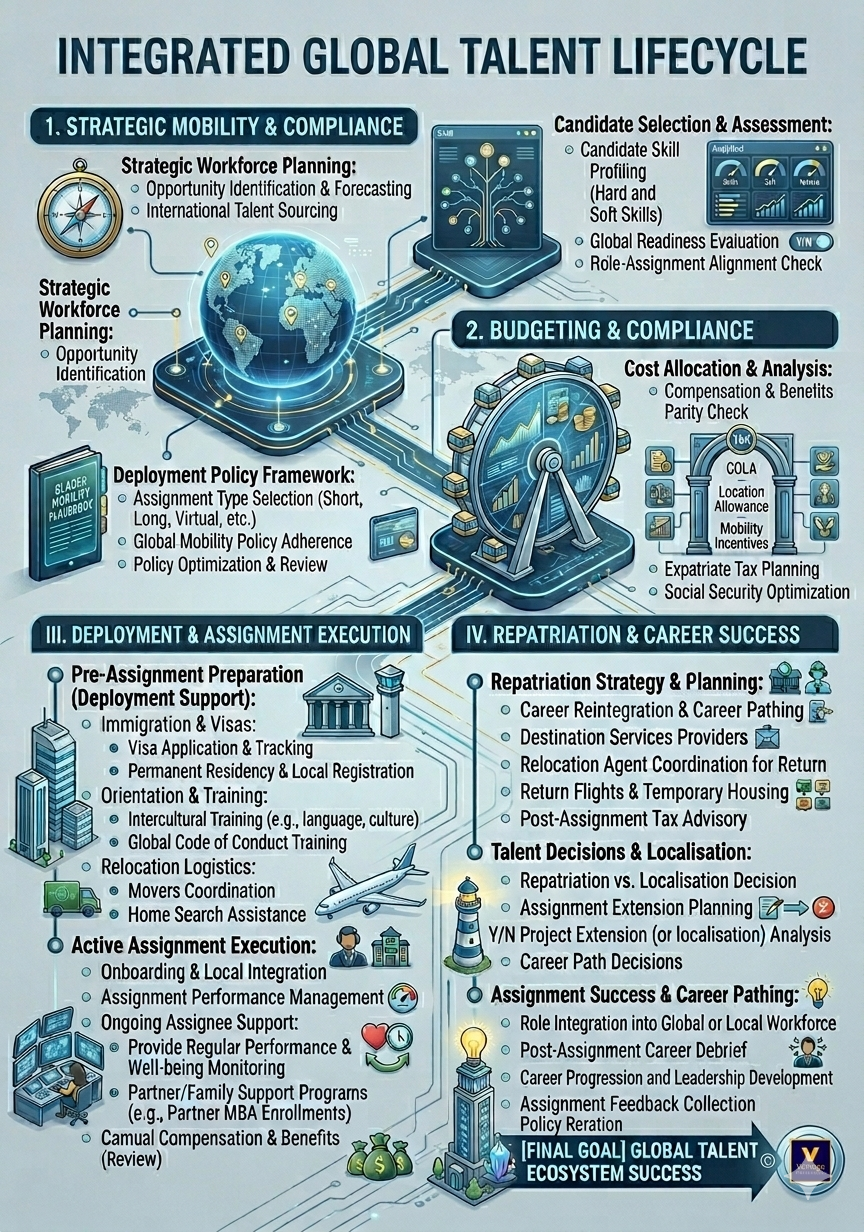
International mobility remains a powerful lever for business growth. Whether deploying senior leaders to establish new markets or building capability in emerging regions, long-term assignments are a cornerstone of many global talent strategies.
Typically lasting between one and five years, these assignments require thoughtful planning – particularly when it comes to reward, benefits and employee support. A well-designed policy doesn’t just control cost; it protects employee engagement, ensures compliance and strengthens your employer brand.
What Is a Long-Term Assignment?
Long-term international assignments usually span one to five years and are commonly used to:
- Fill critical skills gaps
- Support leadership or strategic roles
- Develop high-potential talent
- Transfer knowledge across regions
- Launch or stabilise new operations
For many organisations, a formal global mobility policy outlines the terms and conditions that apply to both the employee and their accompanying family members.
Importantly, the purpose of the assignment should drive policy design. A senior strategic appointment may warrant a different reward structure from a developmental or operational placement.
Choosing the Right Remuneration Approach
At the heart of any long-term assignment policy is the compensation model. Broadly, organisations tend to adopt one of three approaches:
- Home-based pay
- Host-based pay
- Global pay
Each has distinct advantages, challenges and suitability depending on the nature of the assignment and the long-term workforce strategy.
1. Home-Based Pay (The Balance Sheet Approach)
The home-based approach, often referred to as the balance sheet method, remains the most widely used compensation structure for long-term assignments.
Under this model:
- The employee’s salary remains anchored to home-country pay scales
- Adjustments are made to preserve home-country purchasing power
- Tax equalisation ensures the employee pays no more (or less) tax than they would at home
- Allowances are provided to offset assignment-related costs
What’s Typically Included?
A comprehensive package often covers:
- Pre-assignment preparation and cultural training
- Relocation and removals
- Housing and utilities support
- Travel, transport and home leave
- Family assistance (including education and partner career support)
- Medical, health, security and wellbeing provision
- Cost of living and location allowances
- Mobility or hardship premiums where appropriate
- Ongoing compliance support
The principle is simple: the assignee should be financially neutral – neither advantaged nor disadvantaged by accepting the assignment.
One major advantage is ease of repatriation. As salary remains linked to the home structure, returning to the home country is administratively straightforward.
2. Host-Based Pay (Local or Host-Plus Approach)
Host-based pay aligns the assignee’s salary with local market rates in the destination country.
In its purest form, this would mean complete alignment with local employees. However, this is rarely implemented without modification. Most organisations adopt a “host-plus” structure, where additional support recognises the extra responsibilities and transitional costs of working abroad.
Common enhancements may include:
- Housing support
- Education assistance
- Limited relocation benefits
- Transitional allowances
When Does Host-Based Pay Work Well?
This approach tends to work best when:
- Net income levels between home and host locations are broadly comparable
- The assignment is likely to lead to localisation
- The organisation aims to integrate the employee into the host market long term
However, it requires careful modelling of:
- Income tax exposure
- Social security implications
- Pension continuity
- Cost of living differences
If host pay is significantly lower than home earnings, the role may be unattractive. Conversely, if it is substantially higher, repatriation can become challenging.
3. Global Pay (International Cadre Approach)
For employees who are permanently internationally mobile and move from one country to another without returning to a home base, a global compensation structure may be appropriate.
This approach:
- Maintains equity with other globally mobile employees
- Detaches pay from a specific home-country benchmark
- Supports frequent cross-border transitions
Global pay models are often complex, particularly when assignments span countries with very different salary norms, tax regimes and living costs. They are typically used for senior international executives or specialist talent operating across multiple regions.

Designing Policy Around Assignment Purpose
A “one-size-fits-all” model rarely works in global mobility.
Key design considerations include:
- Assignment objective (strategic, operational, developmental)
- Seniority and grade
- Duration and likelihood of repatriation
- Home and host country pairing
- Long-term workforce planning strategy
Some organisations operate multiple policy tiers to reflect different employee populations and assignment types. Clear communication is essential to ensure fairness, manage expectations and protect employee engagement.
Beyond Pay: The Human Factor
While compensation structures are critical, successful long-term assignments depend just as much on:
- Family readiness and support
- Cultural integration
- Clear career pathways post-assignment
- Structured repatriation planning
Without proper reintegration planning, organisations risk losing the very talent they invested in developing internationally.
Building a Policy That Works
- A strong long-term assignment policy should:
- Align with business strategy
- Balance cost control with talent attraction
- Protect compliance across jurisdictions
- Support employee wellbeing
- Enable smooth repatriation or onward mobility
As global mobility continues to evolve, organisations must regularly review their approach to ensure it reflects changing workforce expectations and regulatory landscapes.
At Vantage Relocation, we work with organisations to design, implement and refine international assignment frameworks that are commercially sound and people-focused.
If you are reviewing your long-term assignment policy or planning expansion into new markets, our team would be delighted to support your strategy.